Mastering PLCs: Industrial Automation, Logic, Safety & Reliability
By Peter Alkema
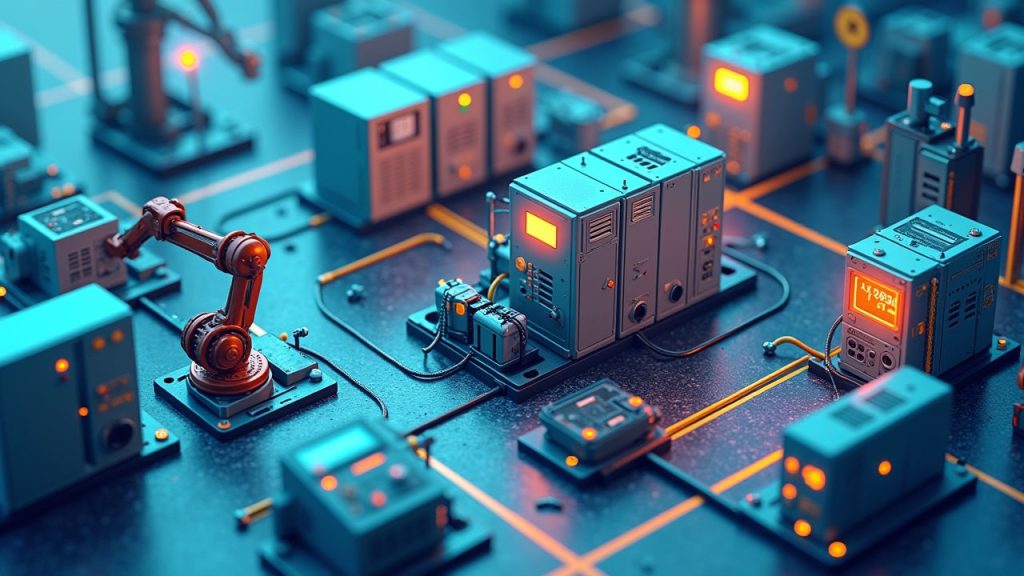
PLC-based automation connects process logic with equipment, interfaces and operational responsibilities.
$79.00 Buy this course
- Format
- Course
- Lessons
- 101
- License
- PLR
What's in the PLR package
- Understanding PLCs_ Industrial Control Logic, Reli_57c72091-5fe2-4ebe-ab61-e52234f9a614.zip 3.5 GB
Download links unlock in your account right after purchase.
Curriculum
- Lesson: Fundamental Concepts and Historical Background of
- Lesson: Key Roles of Programmable Logic Controllers in Industrial Automation Environments
- Lesson: Distinguishing Programmable Logic Controllers from Other Control System Technologies
- Lesson: The Evolution from Electromechanical Relays to Modern Programmable Logic Controllers
- Lesson: Overview of Industrial Sectors Relying on Programmable Logic Controller Solutions
- Lesson: How Industrial Processes are Represented as Logical Sequences and Decision Points
- Lesson: Deterministic Logic and Its Importance for Predictability in Industrial Systems
- Lesson: Real-Life Cases Showing Programmable Logic Controller Decision-Making in Action
Show 93 more
- Lesson: Why Programmable Logic Controllers are Favored for Repeatable, Critical Operations
- Lesson: Industry Examples: Conveyor Sorting and Bottling Using Logical Process Representation
- Lesson: Major Components: Processing Units, Input and Output Modules, and Power Supply
- Lesson: Enclosure, Mounting, and Environmental Protection in Programmable Logic Controllers
- Lesson: Impulse Withstand and Noise Immunity: Hardware Design for Industrial Environments
- Lesson: Plug-In Modules and Scalability to Meet a Range of Application Requirements
- Lesson: Comparing Designs: Compact versus Modular Programmable Logic Controllers in Factories
- Lesson: Binary Logic, ONOFF Control, and Process States Wi
- Lesson: State Machines: Modeling Process Steps Using Relay Logic and Programmable Controllers
- Lesson: Timers, Counters, and Sequence Control in Industrial Automation Applications
- Lesson: Applications Needing Reliable State Transitions: Mixing Tanks and Assembly Lines
- Lesson: Industry Case Study: State-Based Logic in a Modern Water Treatment Facility
- Lesson: Defining Deterministic Control and Its Significance in Critical Industrial Operations
- Lesson: Eliminating Ambiguity: Repeatability and Safety in Automated Process Environments
- Lesson: How Predictable Control Reduces Downtime and Increases Trust in System Performance
- Lesson: Case Analysis: Avoiding Catastrophic Failures Through Deterministic Logic
- Lesson: Human Factors: Operator Trust in System Predictability and Behavioral Consistency
- Lesson: Redundant Designs: Ensuring Operations When Primary Controllers Encounter Failures
- Lesson: Detection, Reporting, and Response to Faults in Programmable Controller Hardware
- Lesson: Programmable Logic Controllers in Safety-Critical Infrastructure: Power Plants and More
- Lesson: Lifecycle Engineering: Planning for Long Operational Lifetimes in Harsh Environments
- Lesson: Case Study: Redundant Controller Design in Oil Refinery Operations for High-Reliability
- Lesson: Centralized versus Distributed Architectures for Control in Large-Scale Facilities
- Lesson: Networking Programmable Logic Controllers Throughout Complex Operational Systems
- Lesson: Data Collection, Plant Historians, and Control Room Information Integration
- Lesson: Scaling Industrial Control: Adding Process Lines and Equipment to Existing Networks
- Lesson: Case Study: System-Wide Programmable Logic Controller Architecture in Modern Factories
- Lesson: Physical Hazards Faced by Programmable Logic Controllers in Industrial Environments
- Lesson: Designing for Electrical Noise Immunity in High-Energy Processing Facilities
- Lesson: Environmental Controls: Humidity, Vibration, and Temperature Protection Strategies
- Lesson: Use of Shielded Enclosures and Filtering to Protect Control System Hardware
- Lesson: Case Study: Ensuring Reliability of Controllers in Steel Manufacturing Environments
- Lesson: Operator Interfaces: Human�Machine Interface Panels and Visualization Strategies
- Lesson: Alarm Management: Prioritization, Notification, and Safety Response
- Lesson: Real-Time Monitoring and the Importance of Display Clarity for Operators
- Lesson: Operator Training and the Ergonomics of Automated Plant Control Stations
- Lesson: Incident Review: Human�Machine Collaboration During Plant Startup and Shutdown
- Lesson: Understanding Fail-Safe Design and Emergency Shutdown Protocols in Automation
- Lesson: Safety Interlocking: How Controllers Enforce Access and Operational Boundaries
- Lesson: Layered Protection: Using Programmable Logic Controllers for Sequential Safety
- Lesson: International Functional Safety Standards and Compliance in Control Systems
- Lesson: Case Study: Safety Roles of Controllers in Automotive Manufacturing and Assembly
- Lesson: Routine Diagnostics, Self-Testing, and Predictive Maintenance Integration
- Lesson: Planning for Spare Parts, Repairs, and Effortless System Upgrades
- Lesson: Extending Operational Life: Environmental and Load Considerations for Hardware
- Lesson: Roles of Preventive Maintenance in Reducing Unplanned Downtime
- Lesson: Case Study: Improving Controller Longevity at a Pharmaceutical Production Plant
- Lesson: What Supervisory Control and Data Acquisition Is, and Its Relationship with PLCs
- Lesson: Data Aggregation: Using Programmable Controllers for Efficient Plant Data Collection
- Lesson: Interfacing Control Logic with Business and Manufacturing Execution Systems
- Lesson: Industrial Examples of Multi-System Operations and Enterprise Integration
- Lesson: Case Study: Seamless Control Integration in Food and Beverage Production Lines
- Lesson: Understanding the Automation Stakeholder Ecosystem in Modern Factories
- Lesson: How Control System Engineers Collaborate with Process and Facility Managers
- Lesson: Decision-Making in High-Stakes and Regulated Industrial Operations
- Lesson: Maintaining Communication: Reporting, Documenting, and Escalating System Events
- Lesson: Case Study: Interdepartmental Coordination During Large-Scale Automation Upgrades
- Lesson: Programmable Logic Controllers in Water Supply, Wastewater, and Utility Distribution
- Lesson: Remote Monitoring and Geographically Dispersed Infrastructure Challenges
- Lesson: Resilience Planning: Maintaining Control Under Grid Failures or Environmental Disasters
- Lesson: Regulatory Compliance and Reporting in Public Works and Utilities
- Lesson: Case Study: Municipal Water Management Using Reliable PLC Deployments
- Lesson: Critical Process Control in Petrochemical, Pulp and Paper, and Mining Facilities
- Lesson: Managing Complexity: Multi-Zone Control and Hierarchical System Approaches
- Lesson: Automation for Throughput Maximization and Quality Assurance
- Lesson: Data Logging, Environmental Reporting, and Regulatory Documentation
- Lesson: Case Study: Programmable Logic Controllers as Backbone for an Integrated Industrial Plant
- Lesson: Reasons for Modernizing Control Logic in Existing Plant Operations
- Lesson: Integrating Legacy Equipment with Newer Programmable Logic Controller Solutions
- Lesson: Risks, Barriers, and Planning for Effective Transition in Industrial Upgrades
- Lesson: Best Practices for Managing Change and Training Process Stakeholders
- Lesson: Industry Example: Migrating from Hardwired Relays to Modern Controller Platforms
- Lesson: Cybersecurity Threats Facing Modern Industrial Automation Networks
- Lesson: Physical Security: Preventing Onsite Tampering and Unauthorized Access
- Lesson: Securing Remote Connections and Field Devices in Distributed Operations
- Lesson: Incident Response and System Recovery Planning for Secure Industrial Operations
- Lesson: Case Study: Cybersecurity Failures and Their Impacts on Operational Safety
- Lesson: The Shift Toward Edge Computing and Distributed Intelligence in Industry
- Lesson: Growing Role of Artificial Intelligence and Data Analytics in Process Optimization
- Lesson: Wireless Connectivity and the Internet of Things in Modern Control Applications
- Lesson: Continuous Improvement: Incorporating New Technologies with Proven Reliability
- Lesson: Futuristic Case Studies: Next-Generation Smart Factories and Infrastructure
- Lesson: Mapping Regulatory Bodies and Safety Standards for Industry Automation
- Lesson: The Role of Documentation for Maintenance, Auditing, and Safety Investigations
- Lesson: Documentation Tools, Electronic Records, and Compliance Verification
- Lesson: Handling Inspections, Incident Reviews, and Compliance Audits in Industrial Settings
- Lesson: Case Study: Navigating Complex Regulatory Requirements in Pharmaceutical Manufacturing
- Lesson: Reviewing Key Lessons about Logic, Reliability, and Operational Context
- Lesson: Synthesizing Real-World Applications and Industrial Case Study Insights
- Lesson: Best Practices for Deploying, Operating, and Managing Programmable Logic Controllers
- Lesson: Strategizing for the Future: Policy, Technology, and Workforce Considerations
- Lesson: Capstone: Integrating Logic, Reliability, and Context for Sustainable Automation Success
- Lesson: Resources
About this course
PLC-based automation connects process logic with equipment, interfaces and operational responsibilities. This course introduces industrial-control concepts for learners examining how the parts of an automation system fit together.
Binary logic, state machines and sequencing provide the foundation. Processors, input/output, power and environmental protection then connect that logic with the physical controller environment.
Consider the controller within the wider operation
Redundancy, diagnostics and lifecycle maintenance are discussed alongside controller networks. SCADA, MES and ERP introduce different levels of information and coordination around the process.
Human-machine interfaces, alarms and industrial security extend the material to the people and systems interacting with the controller. Emerging control concepts broaden the overview.
The course focuses on concepts and architecture. Work on industrial equipment requires the training, procedures and authorization appropriate to the installation.
Use PLR for industrial-automation education
With PLR, you can modify, rebrand and resell the training. You could tailor it for an introductory automation offer or use it alongside your own equipment-specific instruction. Examples from your audience’s industry can help connect the system concepts with familiar processes.
License rights
| Right | PLR |
|---|---|
| Selling the course | |
| Product may be sold separately | YES |
| Product may be bundled with other products | YES |
| Product can be a bonus for another product | YES |
| Can be sold as a physical product | YES |
| Can be sold as a digital product | YES |
| Passing on rights | |
| Can offer Resale Rights | NO |
| Can offer Master Resale Rights | NO |
| Can offer Private Label Rights | NO |
Show all 23 rights Show fewer rights
| Right | PLR |
|---|---|
| Memberships, bonuses and lists | |
| Can be added to paid membership sites | YES |
| Can add bonuses to the Product for sale | YES |
| Can be used to build a list | YES |
| Rebranding and editing | |
| You may put your own name on the sales letter | YES |
| You may rename the product | YES |
| You may edit the sales material | YES |
| You may edit the content of the product | YES |
| You may use the source code/material to create new products | YES |
| You may use the name(s) of the author/creator/seller of the Product | YES |
| Can translate the course into other languages | YES |
| Not allowed with any license | |
| Can be used for YouTube or other free video sites | NO |
| Can be added to free membership sites | NO |
| Can be given away for free | NO |
| Can be used or sold on Uthena | NO |
| Can be used or sold on Soofos, Udemy, Skillshare or other course marketplaces you don't own | NO |
Questions
What do I receive with a PLR or MRR license?
Downloadable package available: the complete course comes as files you download. The lessons are listed below; their online videos are still being added. PLR and MRR include a license key. Sales copy, editable formats and extras depend on the supplied package; check the listed contents.
What does lifetime access mean?
You can follow the course online for as long as it is available on Uthena. Downloadable files are guaranteed for 12 months from your purchase, so download them and keep your own copy.
Can I cancel my order?
Yes, within 7 days of your purchase: request a refund from your Uthena account. After 7 days an order can no longer be cancelled.
What if I want to speak to someone?
Email info@uthena.com, or support@uthena.com about an order, or use the contact form. We reply within two business days.
Related courses
-
Educational Courses -
Educational Courses Intro to LLM Security – OWASP Top 10 for Large Language Models
Joseph Holbrook from $69.00 PLR -
Educational Courses Certified Strategic Generative AI Professional (CSGAIP) Crash Course
Joseph Holbrook from $159.00 PLR -
Educational Courses General Data Protection Regulation GDPR for the Workplace
Joseph Holbrook from $69.00 PLR